Vietnamese Tones Explained: A Complete Guide for Beginners (With Southern Dialect Focus)
Learn all 6 Vietnamese tones with clear explanations, examples, and Southern dialect notes. Discover why Southern Vietnamese only has 5 spoken tones and how to practice them effectively.
Vietnamese Tones Explained: A Complete Guide for Beginners (With Southern Dialect Focus)
Last updated: March 2026 · Reading time: 12 minutes
Vietnamese has six tones. That single fact stops more people from learning the language than anything else.
But here's what most guides won't tell you: if you're learning Southern Vietnamese — the dialect spoken across Ho Chi Minh City, the Mekong Delta, and by most of the Vietnamese diaspora worldwide — you really only need to master five tones. The Southern dialect merges two of the six into one, making the system more approachable than it first appears.
This guide breaks down every Vietnamese tone with clear explanations, practical examples, and specific notes on how each tone sounds in the Southern dialect. Whether you're reconnecting with family, preparing for a trip to Vietnam, or tackling Vietnamese as your next language challenge, this is the foundation everything else builds on.
What Are Tones, and Why Do They Matter?
In English, changing your pitch changes the emotion of a sentence. "Really?" (rising pitch = question) sounds different from "Really." (falling pitch = statement), but the word itself stays the same.
In Vietnamese, changing your pitch changes the word itself. The syllable "ma" has six completely different meanings depending on the tone you use:
| Tone | Word | Meaning |
|---|---|---|
| Ngang (level) | ma | ghost |
| Sắc (rising) | má | mother, cheek |
| Huyền (falling) | mà | but, that |
| Hỏi (dipping-rising) | mả | grave, tomb |
| Ngã (broken rising) | mã | horse, code |
| Nặng (heavy drop) | mạ | rice seedling |
This isn't just a party trick — it's how the language works at every level. Saying the wrong tone doesn't give you an accent. It gives you a different word. Ask for "má" (mother) with the wrong tone and you might say "mả" (grave). Context usually saves you, but getting tones right is what separates being understood from being confusing.
The Six Vietnamese Tones (With Southern Pronunciation)
Most guides on Vietnamese tones describe the Northern (Hanoi) dialect and leave it at that. This guide focuses on how each tone actually sounds in Southern Vietnamese — because that's what you'll hear in Saigon, across the southern provinces, and in most overseas Vietnamese communities.
1. Thanh Ngang — The Level Tone (No Mark)
What it sounds like: A flat, steady pitch in the middle of your range. No movement up or down. Think of it as your "neutral" speaking voice, held even.
How to write it: No diacritic mark at all. When you see a Vietnamese word with no tone mark on the vowel, it carries the level tone.
Example: ma (ghost), ba (three), đi (to go)
Tip: This is the easiest tone because you're already doing it. When you say a word in English with no particular emotion or emphasis — that flat, matter-of-fact pitch — you're in the right zone.
Southern note: Sounds essentially the same as in Northern Vietnamese. No regional difference here.
2. Thanh Sắc — The Rising Tone ( ´ )
What it sounds like: Start at a comfortable mid pitch and rise sharply upward. Think of the way your voice rises at the end of a surprised "What?!" — that upward sweep is the sắc tone.
How to write it: An acute accent over the vowel: á, é, ó, ú
Example: má (mother/cheek), bán (to sell), tốt (good)
Tip: Make it decisive. The rise should feel intentional and firm, not a tentative question. In Southern Vietnamese, this tone tends to be slightly more relaxed and lower in starting pitch than the sharp, tense rise you hear in Hanoi, but the direction is the same — up.
Southern note: Slightly softer and more relaxed than the Northern version, but clearly rising. No voice quality change needed — just pitch.
3. Thanh Huyền — The Falling Tone ( ` )
What it sounds like: Start at a mid-to-low pitch and let it fall lower. It's a gentle descent, like sighing or saying "oh well" with resignation. The pitch drops steadily.
How to write it: A grave accent over the vowel: à, è, ò, ù
Example: mà (but/that), bà (grandmother/Mrs.), và (and)
Tip: This tone is low and falling. Don't confuse it with the nặng tone (which also starts low but drops abruptly and cuts off). Huyền has a smooth, gradual descent with no sudden stop.
Southern note: Very similar across all dialects. In the South, it may sound slightly breathier than in the North, but the contour — steady downward fall — is consistent.
4. Thanh Hỏi — The Dipping-Rising Tone ( ̉ )
What it sounds like: Start at a mid pitch, dip down, then rise back up. Think of the skeptical way you might say "Really?" — your voice drops briefly then comes back up. That dip-and-rise is the hỏi tone.
How to write it: A hook diacritic above the vowel: ả, ẻ, ỏ, ủ
Example: mả (grave/tomb), bảo (to tell), hỏi (to ask)
Tip: The dip is the key. If you just rise (like sắc) without dipping first, you've said the wrong tone. Let your pitch sink briefly, then bring it back up.
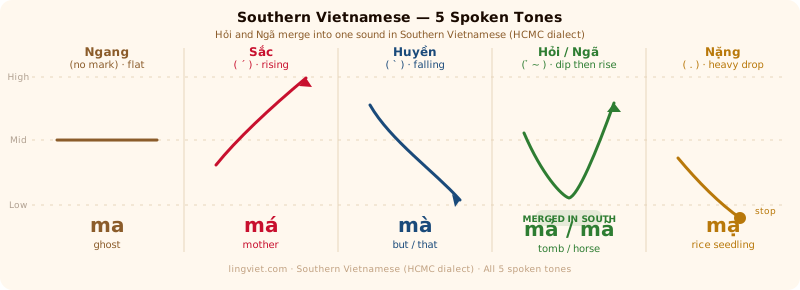
Southern note — this is important: In Southern Vietnamese, the hỏi tone and the ngã tone (below) have merged into the same sound. Southern speakers pronounce both as a smooth dipping-rising tone without the creaky voice or glottal break that distinguishes them in the North. This means if you're learning Southern Vietnamese, you can treat hỏi and ngã as one tone. The written marks stay different, but the spoken pronunciation is the same.
5. Thanh Ngã — The Broken Rising Tone ( ~ )
What it sounds like in Northern Vietnamese: Start mid, rise, hit a glottal break (a brief catch in your throat, like the pause in "uh-oh"), then continue rising. It's the tone that gives many learners the most trouble because of that break in the middle.
How to write it: A tilde over the vowel: ã, ẽ, õ, ũ
Example: mã (horse/code), ngã (to fall), dễ (easy)
Southern note — the big simplification: In Southern Vietnamese, the ngã tone is pronounced identically to the hỏi tone. There is no glottal break, no creaky voice — just the same smooth dipping-rising contour as hỏi. This is the main tonal difference between Northern and Southern Vietnamese, and it's a genuine simplification for learners. Instead of six distinct tones, Southern Vietnamese has five spoken tones.
This doesn't mean you can ignore the ngã mark when reading and writing. The spelling doesn't change. But when you speak Southern Vietnamese, you produce the same sound for both hỏi and ngã words.
6. Thanh Nặng — The Heavy Drop Tone ( . )
What it sounds like: Start low and drop abruptly, cutting off sharply at the bottom. It's heavy and short — the most forceful tone. Think of a blunt, emphatic grunt, or the way you might bark "Stop!" with a hard, cut-off ending.
How to write it: A dot below the vowel: ạ, ẹ, ọ, ụ
Example: mạ (rice seedling), nặng (heavy), một (one)
Tip: The abrupt cutoff is what defines this tone. Your throat closes slightly at the end, stopping the airflow. If the sound trails off instead of stopping cleanly, you're probably producing huyền (the falling tone) instead.
Southern note: In Southern Vietnamese, nặng starts slightly lower and the cutoff may be less dramatically glottalized than in the North, but the short, heavy, downward-dropping character is the same. The cutoff is still there — it's just a bit softer.
Southern Vietnamese Tones at a Glance
Here's the simplified Southern tone system in one table:
| Tone Name | Mark | Pitch Contour | Example |
|---|---|---|---|
| Ngang | (none) | Mid level, flat | ma (ghost) |
| Sắc | ´ | Mid → high rising | má (mother) |
| Huyền | ` | Mid → low falling | mà (but) |
| Hỏi / Ngã | ̉ or ~ | Mid → dip → rise | mả / mã (merged) |
| Nặng | . | Low → abrupt drop | mạ (rice seedling) |
Five spoken tones. Six written marks. That's the Southern system. If you're learning the Saigon dialect — or connecting with family who came from southern Vietnam — this is your roadmap.
Why Most Tone Guides Get This Wrong
Almost every Vietnamese tone guide online focuses on the Northern dialect. There's a historical reason: Northern Vietnamese (specifically the Hanoi accent) is considered the "standard" for education, news broadcasts, and formal contexts within Vietnam. So most textbooks and apps default to it.
But here's the problem: most Vietnamese people living outside Vietnam trace their roots to the South. The waves of emigration after 1975 came overwhelmingly from Saigon and the southern provinces. If you're a Vietnamese American learning to talk to your grandparents, a partner learning to speak with your spouse's family, or an expat living in Ho Chi Minh City — you need Southern Vietnamese.
Learning the Northern six-tone system when your target is Southern doesn't just add unnecessary complexity. It can actively confuse you, because you'll be trying to produce a tonal distinction (hỏi vs. ngã) that the people around you don't make. You'll be solving a problem that doesn't exist in your context.
Common Mistakes Beginners Make With Tones
Treating tones as optional
Tones aren't decoration. They're as fundamental as the consonants and vowels. Skipping tones is like spelling every English word without vowels — people might guess what you mean, but it's painful for everyone.
Exaggerating too much, or too little
New learners often either mumble their tones (out of self-consciousness) or exaggerate them to the point of sounding robotic. Aim for clear and natural. Listen to native speakers in conversation — their tones are fluid and integrated, not dramatic.
Mixing up huyền and nặng
Both are low tones, but huyền falls gradually while nặng drops and cuts off. The cutoff is the difference. If you're not stopping the airflow at the end of nặng, practice saying "uh-oh" and notice how your throat closes on the "oh" — that's the kind of closure you want.
Studying Northern tones when learning Southern Vietnamese
If your teacher, your family, or your life is in southern Vietnam or the diaspora, learn the five-tone Southern system first. You can always learn to distinguish hỏi and ngã later if you need to understand Northern speakers — but don't burden yourself with a distinction your target dialect doesn't make.
How to Actually Practice Vietnamese Tones
1. Listen before you speak
Spend time listening to Southern Vietnamese speakers before trying to produce the tones yourself. Vietnamese podcasts, YouTube channels, TV shows set in Saigon, or even TikTok creators speaking Southern Vietnamese all work. Your ear needs to tune in before your mouth can follow.
2. Practice in minimal pairs
Use the "ma" series (ma, má, mà, mả, mã, mạ) and practice saying each one slowly, then faster. Record yourself and compare. Then try other sets: ba, bá, bà, bả, bã, bạ. The repetition trains your muscle memory.
3. Drill in context, not isolation
Tones are easier to remember when attached to real words and sentences, not practiced as abstract pitch patterns. Learn the tone as part of the word. When you learn "bán" (to sell), don't just memorize "rising tone" — memorize the sound of "bán" as a complete unit.
4. Use spaced repetition
Tones stick when you encounter them repeatedly over time. Every time you review a word in your vocabulary deck, you're reinforcing its tone along with its meaning. This is one of the reasons spaced repetition systems (like the one built into LingViet) are so effective for tonal languages — the tone is baked into every review.
5. Read along while listening
When you can see the tone marks while hearing the tones, your brain builds a visual-auditory connection. Reading a Vietnamese passage while listening to it spoken is one of the fastest ways to internalize the tone system. Each reading and listening exercise reinforces which mark corresponds to which sound.
Tones and the Vietnamese Alphabet: A Quick Note on Diacritics
Vietnamese uses the Latin alphabet with additional diacritics. This trips up many beginners because there are two types of marks on Vietnamese vowels:
Vowel marks change which vowel sound you're making. The hat (^), breve (˘), and horn (ơ, ư) are part of the vowel itself — they're not tones. For example, "o", "ô", and "ơ" are three different vowels, just as "a", "e", and "i" are different vowels in English.
Tone marks change the pitch contour. These are the five marks we've discussed (´ ` ̉ ~ .) plus the absence of a mark (ngang).
A single vowel can carry both. The word phở (as in the soup) has a vowel mark (the horn on ơ) and a tone mark (the hỏi hook). The vowel tells you the sound; the tone tells you the pitch.
This matters because when you see a word with two marks on it, you're not looking at two tones. You're looking at one vowel identity and one tone. Once you understand the distinction, the writing system becomes much more logical.
What to Do Next
Vietnamese tones are the first wall every learner hits. But they're a shorter wall than most people think — especially if you're learning the Southern dialect, where five spoken tones replace six.
The key is consistent practice: hearing tones in context, producing them regularly, and reviewing vocabulary with the tones built in. Every time you encounter a word, you're reinforcing its tone.
If you're ready to start practicing, LingViet generates fresh reading, listening, and writing exercises in Southern Vietnamese every day — so you hear and practice tones in natural context, not isolated drills. Every word you encounter can be saved to your personal vocabulary deck with one click, and spaced repetition brings it back at exactly the right time.
Start learning Southern Vietnamese for free →
Have questions about Vietnamese tones or the Southern dialect? Leave a comment or reach out — we'd love to hear from you.
Ready to practice what you've learned?
LingViet generates fresh Southern Vietnamese reading, listening, and writing sessions every day — free to start.
Start learning free →